
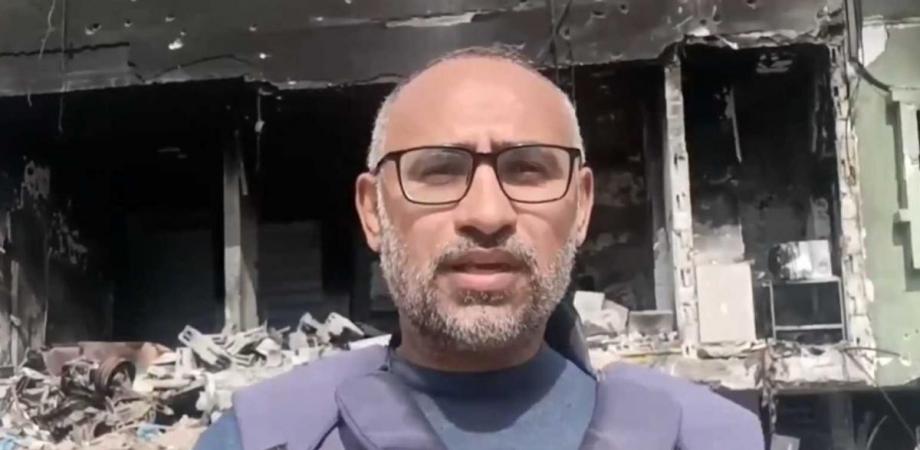
SAFA - A recently released image of imprisoned Palestinian journalist Mohammad Arab, captured during an Israeli court hearing, has sparked widespread concern in Gaza, as his strikingly altered appearance has drawn renewed attention to the harsh conditions, suffering, and torture endured by Palestinian detainees in Israeli prisons.
Arab appeared with a pale, gaunt face and visibly weakened features after more than two years in detention. His beard had turned gray, presenting a stark contrast to the journalist remembered by colleagues before his arrest.
For many observers, the courtroom image was more than a brief appearance. It offered a stark visual representation of the physical toll of prolonged detention and renewed attention to the conditions of Palestinian prisoners, particularly journalists held in Israeli custody.
Widespread Impact on Detainees
Islam Abdo, director of media affairs at the Palestinian Ministry of Prisoners’ Affairs, described Arab’s appearance as shocking, telling Palestine newspaper that the journalist had changed dramatically, with signs of aging, illness, and weight loss visible on his face.
Abdo stated that the image also highlighted the conditions facing approximately 9,500 Palestinian prisoners in Israeli prisons, who had been deprived of protections guaranteed under international and humanitarian law.
He said that prisoners had been denied family visits and communication with the outside world, while access to legal representation and judicial proceedings had also been severely restricted.
The Arabs’ appearances, Abdo said, showed the effects of hunger, torture, and disease among Palestinian prisoners, which he called part of a broader policy of retaliation against prisoners.
Mohammad Yassin, director of the Palestinian Journalists Forum, said Arab’s appearance after more than two years in detention provided a stark indication of the deterioration in his health.
Yassin noted that the journalist’s physical condition had changed considerably since his arrest in 2024, when he was detained at Al-Shifa Medical Complex in Gaza.
He added that Arab had been subjected to various forms of torture and deprivation during his imprisonment and denied contact with his family.
Yassin also stated that Arab had been prevented from seeing his own reflection in a mirror, saying the journalist was unable to see his face until two years after his detention.
He described the photograph as a “visual testimony” to Israeli violations against Palestinian journalists, particularly those held in Israeli prisons.
Approximately 40 Palestinian journalists, including five women, are currently being held in Israeli prisons.
Calls for International Intervention
The Palestinian Journalists Forum called on the international community, human rights organizations, and journalists’ unions to pressure Israel to release imprisoned Palestinian journalists.
Yassin also urged international organizations to visit detainees, assess their conditions, and ensure that they are held in humane conditions and afforded fair legal proceedings until their release.
He further called for those responsible for targeting, pursuing, and imprisoning journalists to be held accountable, arguing that such practices violate international law and humanitarian conventions that recognize journalists as civilians and provide protections for their work.
Yassin condemned the Israeli continued disregard for international and humanitarian laws protecting press freedom and journalists.
The image of Mohammad Arab has since become a stark symbol of the physical toll of prolonged detention, while drawing renewed attention to Palestinian journalists who remain behind bars.
Source : Safa News


