
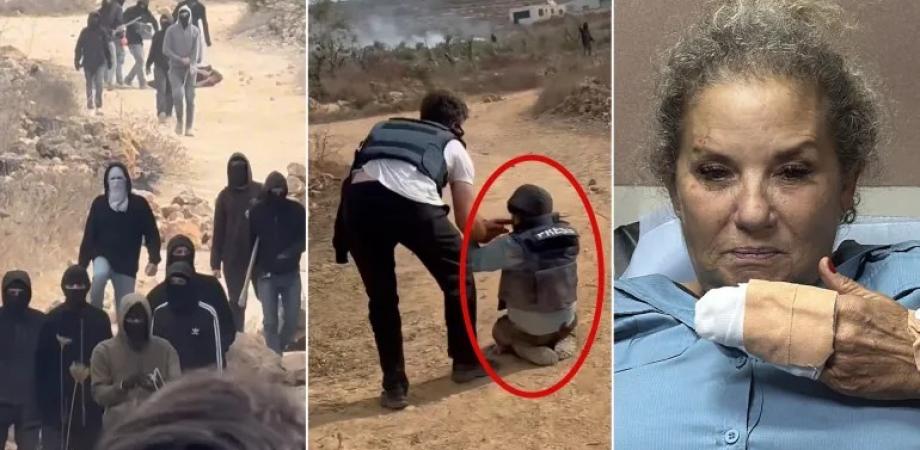
SAFA — Veteran American photojournalist Heidi Levine has spent more than four decades documenting wars, violence, and human suffering. But on October 16, 2026, while covering Israeli settler attacks against Palestinian olive harvesters in the occupied West Bank, she became the victim of the brutality she had come to expose.
Masked Israeli settlers allegedly surrounded, kicked, and beat the veteran Washington Post photographer in the olive groves of Khirbet Abu Falah, northeast of Ramallah, despite her protective vest clearly identifying her as a member of the press.
Her cameras and phone were stolen. She suffered fractures to several vertebrae and other injuries requiring hospitalization and surgery.
The attack left an American journalist seriously injured. But for Palestinian farmers across the occupied West Bank, the violence that unfolded in Abu Falah was part of a familiar and increasingly dangerous reality.
Israeli settler attacks have turned the annual olive harvest into a season of fear, bloodshed, and destruction, with farmers assaulted, agricultural land set ablaze, and families threatened while attempting to gather the crops on which their livelihoods depend.
A Journalist Beaten While Documenting Settler Attacks
Levine arrived in Abu Falah on Friday morning wearing a helmet and a protective vest marked "PRESS."
Her assignment was to document Palestinian families harvesting olives amid mounting Israeli settler attacks.
According to accounts of the incident, dozens of masked settlers descended on the area, throwing stones at Palestinian residents and setting agricultural land on fire.
The attackers then turned on journalists covering the confrontation.
As Levine attempted to escape, she fell to the ground. Settlers allegedly kicked and beat her repeatedly while she struggled to protect her cameras and belongings.
Her press markings did not stop the assault.
Video footage captured portions of the violence, while witnesses described settlers attacking Palestinians and journalists in the olive groves.
Levine later said her helmet and protective vest may have prevented even more severe injuries.
Instead of returning from the assignment with photographs of Palestinian farmers, she was taken to a hospital with serious spinal injuries.
The journalist who had spent decades documenting the suffering of others was now lying in a hospital bed, recounting her own assault.
Israeli Soldiers Accused of Failing to Stop the Attack
The assault raised further questions about the conduct of Israeli forces stationed near Palestinian communities facing settler attacks.
Witnesses reported that Israeli soldiers were in the vicinity but failed to intervene to stop the violence.
According to The Washington Post, witness accounts and video evidence supported reports that settlers initiated the attack.
The Israeli military subsequently announced an investigation.
From her hospital bed, Levine expressed anger over what she described as the Israeli military's protection of settlers.
She also challenged Prime Minister Benjamin Netanyahu's suggestion that conflicting accounts existed, pointing to the available video evidence and witness testimony.
For Palestinians in the occupied West Bank, allegations of soldiers standing by during settler attacks are part of a broader concern: that armed settlers can assault residents, destroy property, and intimidate communities without facing meaningful consequences.
The attack on Levine brought international attention to those allegations because the victim was an American journalist.
Yet the Palestinian farmers she had come to photograph remain exposed to the same threats long after the cameras leave.
European Diplomats Targeted in Another Settler Assault
Less than 24 hours after the attack on Levine, Israeli settlers reportedly assaulted a European delegation participating in an olive harvest solidarity activity in Al-Taybeh, east of Ramallah.
The delegation included diplomats from France, Belgium, and Poland, along with religious representatives and European local officials.
Video footage showed a French mayor confronting a masked settler before being assaulted. A Belgian diplomatic vehicle was also damaged.
The incidents exposed the growing reach of settler attacks, which have increasingly affected not only Palestinian farmers but also journalists, international volunteers, diplomats, and others accompanying Palestinian communities.
Within two days, an American journalist had been hospitalized and European representatives had come under attack.
The incidents drew condemnation abroad, but they also highlighted a stark disparity in international attention.
Palestinians have documented settler attacks for years, often with little effective intervention. When foreign journalists and diplomats became victims, the same pattern of violence suddenly received heightened scrutiny.
The underlying threat to Palestinian communities, however, remained unchanged.
More Than 1,600 Settler Attacks in Less Than Nine Months
The violence in Abu Falah and Al-Taybeh did not emerge in isolation.
According to figures attributed to the United Nations Office for the Coordination of Humanitarian Affairs (OCHA), more than 1,600 Israeli settler attacks resulting in Palestinian injuries, property damage, or both had been documented by September 14, 2026.
That represented an average of approximately 6.7 attacks every day, compared with five daily attacks in 2025.
The reported attacks affected 275 Palestinian communities in less than nine months, nearly matching the 279 communities affected throughout the previous year.
The figures point to a deepening crisis in which attacks are spreading across a growing number of Palestinian villages and agricultural areas.
The consequences go far beyond individual assaults.
Settlers have reportedly damaged homes, vehicles, water pipelines, irrigation systems, crops, and olive trees, while threats and restrictions have made some agricultural land increasingly difficult for Palestinians to access.
According to the UN figures cited in the report, settler attacks and related access restrictions accounted for approximately 60% of displacement linked to demolitions, evictions, violence, and movement restrictions during 2026.
By mid-September, more than 4,300 Palestinians had reportedly been displaced across the West Bank as a result of these combined factors.
The figures describe a crisis in which physical attacks, destruction of property, and restrictions on movement are placing sustained pressure on Palestinian communities.
Palestinian Farmers Face a Harvest of Fear and Destruction
For generations, the olive harvest has been central to Palestinian life.
It provides income for farming families, sustains local economies, and preserves a connection to land cultivated across generations.
But in the occupied West Bank, harvesting olives has become increasingly dangerous.
Farmers attempting to reach their trees face the risk of being beaten, chased away, or attacked by armed settlers. Others discover that their crops have been stolen, their trees uprooted, or their agricultural equipment destroyed.
The destruction of an olive tree is not merely the loss of a single season's harvest. It can erase years of cultivation and deprive a family of future income.
UN figures cited in the report show that the 2025 olive harvest was marked by a sharp increase in settler attacks.
Between early October and late November that year, OCHA documented 185 harvest-related attacks across 70 Palestinian communities.
More than 6,000 olive trees and saplings were reportedly vandalized.
October 2025 alone recorded 264 settler attacks involving injuries or property damage, an average of approximately eight attacks per day and the highest monthly figure recorded by OCHA since it began documenting such incidents in 2006.
The opening weeks of the 2026 harvest have brought further reports of assaults on farmers and destruction of agricultural property.
Recent reports cited nearly 200 attacks associated with this year's harvest, suggesting that the violence had already reached or exceeded the scale recorded during the entire previous season.
Just days before Levine was assaulted, settler attacks were reported at at least 19 locations across the occupied West Bank in a single day.
The pattern has transformed what should be a season of gathering and celebration into a struggle for physical safety and access to land.
Violence That Threatens to Drive Palestinians From Their Land
The growing number of settler attacks has intensified concerns about the long-term consequences for Palestinian communities.
When farmers cannot safely reach their olive groves, they risk losing their crops and the income needed to support their families.
When roads become dangerous, water networks are damaged, and homes are repeatedly threatened, remaining in a community becomes increasingly difficult.
Such conditions can contribute to displacement even without a formal eviction order.
The pressure is particularly severe for isolated villages and farming communities located near Israeli settlements and outposts.
For these residents, the danger is not limited to a single attack.
It is the uncertainty of whether they can travel safely, cultivate their fields, protect their children, or remain on their land.
The violence documented during the olive harvest illustrates how settler attacks can undermine both immediate security and the long-term survival of Palestinian agricultural communities.
The Scars of an American Journalist, the Daily Reality of Palestinian Farmers
Levine has said she intends to return to her work.
Her determination carries particular significance because the story she set out to document remains unfinished.
The photographs she hoped to take were of Palestinians struggling to harvest olives under the threat of settler attacks.
Instead, images of her own injuries became part of the international coverage.
Her assault, followed by the attack on European diplomats, briefly brought the violence facing Palestinian communities into sharper international focus.
But the danger did not begin when foreign journalists and diplomats became victims.
It was already present in the olive groves, on village roads, and across Palestinian farmland.
After the hospital reports, diplomatic condemnations, and international headlines fade, Palestinian families must still return to their fields.
They must still ask whether they can reach their trees, whether their crops will survive, and whether anyone will intervene when settlers attack again.
Heidi Levine bears the physical scars of an assault she survived while reporting.
Palestinian farmers bear the consequences of a system in which the land they depend on has become a place of repeated attacks, intimidation, and fear.
The attack on Levine did not reveal a new crisis. It exposed, through the suffering of an internationally recognized journalist, the brutality Palestinian communities have been documenting and enduring for years.
Source : Safa News


