
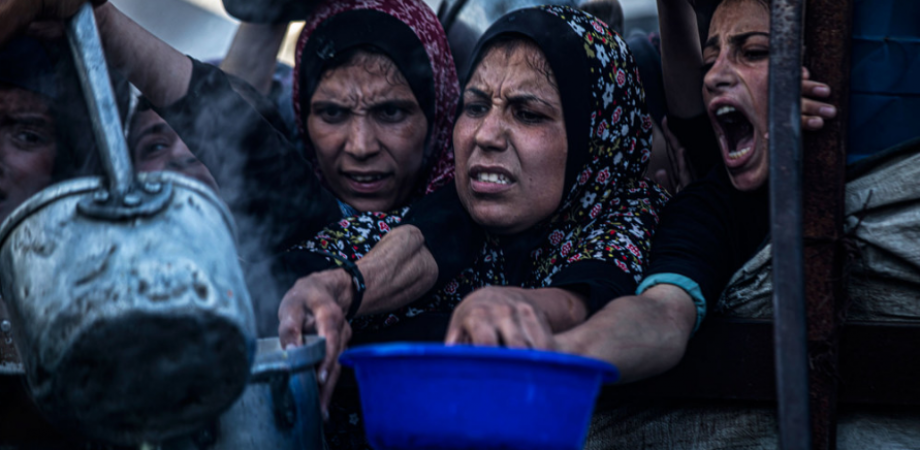
By the end of 2025, life in Gaza had been reduced to a bare struggle for survival. What unfolded over the year was not a sudden humanitarian breakdown but a prolonged and deliberate dismantling of the conditions necessary for human existence. Food, once scarce, became unreachable; shelter grew increasingly fragile; and survival itself was rationed. More than two million people found themselves trapped in an environment where the most basic elements of life were systematically stripped away during the genocidal war.
The erosion of Gaza’s food system followed a clear trajectory. Agricultural land was destroyed, local production wiped out, and supply routes gradually paralysed. Crossings remained tightly restricted, while essential goods were blocked or delayed for months at a time. Bakeries, warehouses and aid distribution points were repeatedly rendered inoperable, leaving families dependent on sporadic handouts that could not sustain an entire population. Over time, the notion of a stable food supply disappeared altogether, replaced by forced scarcity, widespread malnutrition and hunger as a daily reality.
The consequences were visible in hospitals and homes alike. Deaths linked to hunger and dehydration rose steadily, particularly among children and the elderly, while preventable diseases spread rapidly in the absence of medicines and clean water. Medical staff worked without supplies, watching patients deteriorate from conditions that would normally be treatable. Hunger no longer appeared as an emergency, but as a constant condition shaping every aspect of life, from physical health to social cohesion.
Beyond food and health, the collapse extended to Gaza’s ability to function as a society. Municipal services ground to a halt as infrastructure was destroyed and equipment rendered unusable. Waste accumulated, sewage systems failed, and roads were left in ruins. Entire neighbourhoods became uninhabitable, not only because of physical destruction, but because the systems that sustain urban life had been deliberately dismantled. Hunger, pollution and disease fed into one another, creating an environment where survival grew more precarious by the day.
What defined 2025 was not only deprivation, but design. The scale, consistency and coordination of these conditions pointed to a calculated process rather than an accidental outcome. Hunger was not a byproduct of the genocidal war; it became one of its central mechanisms. By the end of the year, Gaza was no longer merely enduring a humanitarian emergency, but confronting the near erasure of life’s foundations, with recovery pushed further out of reach as restrictions and destruction continued.
Source : Safa News


