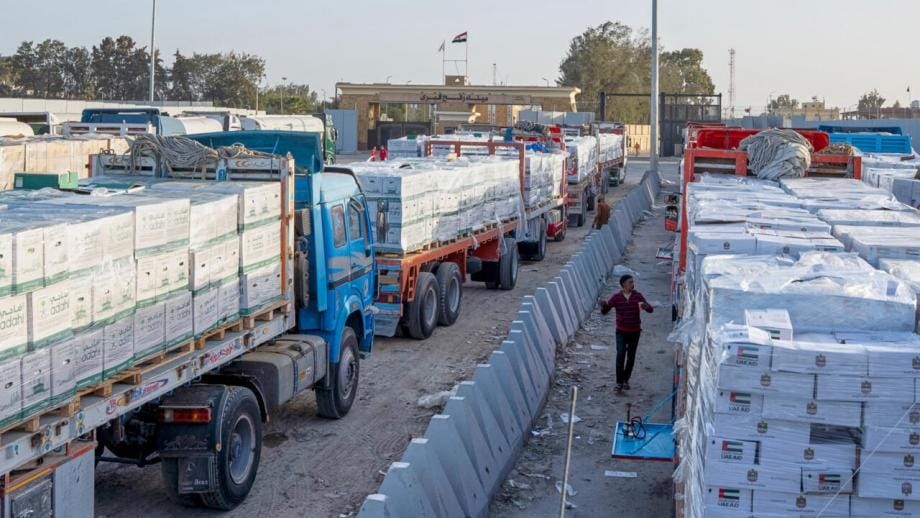
Safa – Representatives of the private sector in the Gaza Strip have warned that the territory's economy is on the verge of total collapse as continued Israeli restrictions on the movement of goods and raw materials, coupled with the devastation caused by the ongoing military offensive, have crippled nearly every productive and service sector.
They called for urgent international action to launch a comprehensive economic recovery plan, beginning with the lifting of restrictions on the entry of goods, machinery, construction materials, and other essential supplies needed for reconstruction. They stressed that these measures are vital to restarting businesses, reviving production, and restoring economic activity.
According to international estimates, direct damage to Gaza's infrastructure and economic assets has reached approximately $30 billion, while reconstruction and economic recovery are expected to require more than $50 billion. Gaza's economy has also contracted by more than 80% over the past year.
Private sector representatives emphasized that meaningful economic recovery depends on easing restrictions on the movement of goods, services, machinery, and equipment, restoring a reliable electricity supply, rehabilitating water and sewage networks, repairing critical infrastructure, and allowing the entry of spare parts needed to operate factories and vehicles.
Economy Nearing Collapse
Industrialist Ali Al-Hayek described Gaza's economic conditions as "beyond description," warning that the remaining businesses are on the verge of shutting down completely.
Speaking to Felesteen, Al-Hayek said that if current conditions persist, Gaza's economy will face total collapse across all sectors, resulting in the loss of tens of thousands of jobs and driving unemployment—already exceeding 50%—even higher. He added that businesses are struggling under mounting debt and severe financial pressures.
Al-Hayek stressed that recovery requires more than simply reopening factories. It also depends on creating an attractive investment climate, facilitating imports and exports, securing funding for productive projects, and restoring purchasing power.
He called for an urgent international donors' conference and urged that donors be allowed to visit Gaza to witness the scale of the destruction firsthand. He also welcomed initiatives aimed at reviving the economy, particularly those led by Arab investors and organizations supporting the Palestinian people.
Construction Sector Near Paralysis
Mohammad Al-Assar, Secretary of the Construction Industries Union, said the construction sector is facing near-total paralysis because of the severe shortage of cement—the primary material required for reconstruction.
Speaking to Felesteen, Al-Assar said continued restrictions on cement imports have prevented the rebuilding of thousands of destroyed homes and public facilities while deepening losses across construction-related industries.
He noted that before the war, concrete block factories accounted for 63.5% of construction-related businesses, marble factories represented 30%, while the remainder included tile and asphalt production, illustrating the scale of the sector's losses.
Al-Assar stressed that reviving the construction sector is essential to Gaza's economic recovery because of its strong links to dozens of industries and its ability to generate thousands of jobs.
Compensation and Expanding Market Access
Meanwhile, Waddah Bseiso, former head of the Wood Industries Union, called for the swift payment of compensation to businesses affected by the war, warning that continued delays are deepening the economic crisis and slowing recovery efforts.
He also urged regional and international efforts to open foreign markets to Palestinian products and expand trade opportunities, given the limited capacity of the local market and weakened purchasing power.
Speaking to Felesteen, Bseiso said Gaza's private sector had demonstrated remarkable resilience by maintaining production and achieving a degree of self-sufficiency despite years of blockade. However, continued restrictions on the entry of raw materials, machinery, equipment, and items classified as "dual-use" now threaten the survival of many industries.
He added that modern industry relies heavily on advanced technology, yet Gaza has endured a chronic electricity crisis for more than 17 years, along with restrictions on telecommunications, internet services, and access to modern technologies, severely limiting the competitiveness of local industries.
Bseiso noted that the war caused widespread destruction to factories and industrial facilities, forcing many to suspend operations and resulting in the loss of tens of thousands of jobs.
Available economic data indicate that more than 70% of Gaza's industrial facilities have ceased operations, with losses estimated in the billions of dollars alongside a sharp decline in Gross Domestic Product (GDP).
He concluded that rescuing Gaza's private sector requires a comprehensive economic recovery plan centered on lifting restrictions on imports and trade, financing reconstruction, restoring essential infrastructure, and creating a stable investment climate capable of reviving production, generating employment, and rebuilding Gaza's economy.