
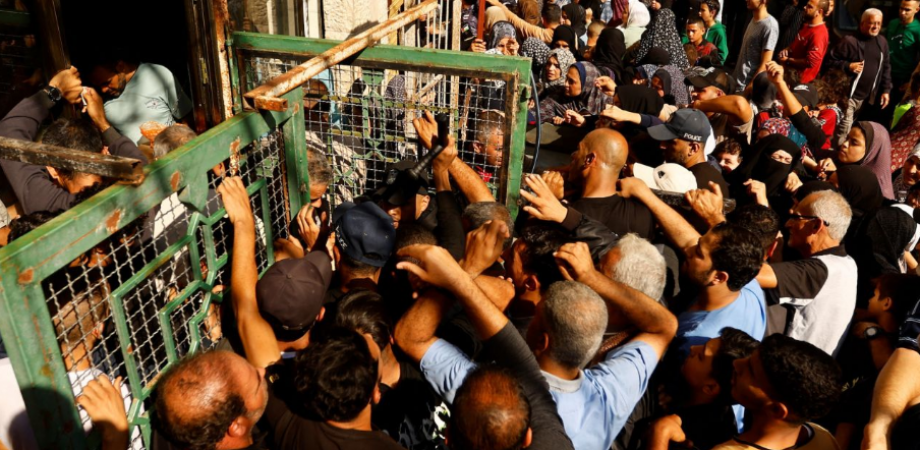
SAFA – The reduction of humanitarian aid to the Gaza Strip has pushed Gaza back into a bread crisis after the World Food Programme (WFP) reduced bread allocations for families and closed several distribution points that had served thousands of Palestinians across the territory.
As supplies continue to dwindle, long queues have reappeared outside bakeries and distribution centres, forcing many Palestinians to travel between multiple locations in search of bread amid continued Israeli restrictions on border crossings and the entry of flour and fuel needed to keep bakeries operating.
In Gaza City and other areas across the Strip, the closure of bread distribution points has disrupted daily life. Families have been forced to head to a limited number of remaining centres, resulting in severe overcrowding and long waiting lines from the early hours of the morning.
Residents said the distances they must travel to obtain bread have increased after nearby distribution points closed. They added that waiting for hours no longer guarantees receiving bread, as supplies frequently run out before many people reach the front of the queue.
Daily Source of Anxiety
Among those affected is 40-year-old Ashraf Abu Marq, who has had to reorganise his daily routine after the closure of the bread distribution point near his home.
Abu Marq said the closure forced him back into long queues after he had relied on the centre to meet his family's daily needs. He said securing a loaf of bread has become a daily source of anxiety, especially because his children depend on it and there are few affordable alternatives.
He added that bread has become the primary food source for many families in Gaza amid declining purchasing power and soaring prices for basic goods. Baking bread at home has also become increasingly difficult because of fuel and electricity shortages and the rising cost of alternatives such as firewood.
Abu Marq said he has spent the past two days worrying about whether he will be able to provide bread for his children as supplies continue to decline and nearby distribution points remain closed.
Meanwhile, 62-year-old Fatima Abdel Hadi said the closure of a nearby bread distribution point has disrupted her daily life, forcing her to walk nearly an hour to reach the closest location where bread is available.
She said that since the reduction in distribution points, she has spent long hours waiting in queues. On the first day alone, she waited more than three hours, turning the simple task of securing bread into an exhausting daily ordeal.
Abdel Hadi expressed concern that the current measures could continue and make access to bread even more difficult, as happened during previous stages of the Israeli genocidal war. She said that even if she could afford flour, she would still be unable to bake because of fuel shortages and the soaring cost of firewood.
She added that delays in obtaining bread also delay preparing meals at home, leaving her orphaned grandchildren waiting until after midday for their first meal.
Their experiences reflect growing concerns over worsening food insecurity in Gaza as the flow of humanitarian aid and essential supplies continues to decline.
According to the Palestinian Ministry of Social Development, Gaza requires around 600 trucks carrying food and essential supplies every day. However, only between 190 and 250 trucks are currently entering the Strip, leaving a shortfall of more than 65% of the minimum daily requirement.
Critical Levels
Aid reductions have also forced several community kitchens and charitable food programmes to shut down, depriving displaced families and vulnerable households of daily meals.
Current estimates indicate that 77% of Gaza's population faces critical levels of food insecurity, including more than 100,000 children at risk of acute malnutrition.
The situation at bakeries reflects the growing dependence of Gaza's population on bread assistance. The Bakers Association said around half of Gaza's residents now rely on subsidised bread assistance, compared with more than 70% during earlier stages of the war, because of reduced bakery production and declining flour allocations.
Kamel Ajjour, owner of Ajjour Bakery Group, said bakeries cannot continue meeting demand without a steady supply of flour and fuel. He explained that the crisis begins with shortages of essential production materials before reaching distribution centres and consumers.
Ajjour said bakeries across Gaza require around 40,000 litres of diesel each day to operate at full capacity, while any reduction in fuel supplies forces them to shorten operating hours and reduce bread production.
He added that demand for subsidised bread has risen sharply because of declining purchasing power and soaring prices for commercially sold bread, leaving thousands of families dependent on limited quantities distributed through aid programmes.
Ajjour explained that keeping bakeries operational depends not only on flour but on an entire supply chain that includes fuel, cooking oils, and spare parts needed to maintain production lines. These items have become increasingly difficult to obtain because of restrictions on the entry of goods into Gaza.
These conditions show that the bread crisis extends well beyond the closure of distribution points and long queues. It is now affecting the ability of bakeries themselves to continue operating. Any further reduction in supplies would immediately threaten thousands of families who depend on bread as their primary daily food source.
Worsening Economic Conditions
Economic analyst Ahmad Abu Qamar said the renewed bread crisis in Gaza is inseparable from the broader economic and humanitarian crisis, noting that available figures reveal a widening gap between residents' actual needs and the volume of aid and goods entering the Strip.
Abu Qamar said Gaza requires at least 600 trucks of humanitarian aid and essential supplies every day, yet actual deliveries remain far below that level. He said humanitarian aid deliveries rarely exceed 60 to 70 trucks a day, most carrying flour and canned food, while other goods enter through commercial channels at prices beyond the reach of most residents.
He said claims of economic improvement bear little resemblance to the reality facing Palestinians in Gaza, where unemployment remains extremely high and most families continue to depend on humanitarian assistance amid deepening poverty and shrinking sources of income.
Abu Qamar added that Gaza's economy has suffered a severe contraction during the Israeli genocidal war, losing much of its productive capacity while restrictions on raw materials and operational supplies continue to cripple nearly every sector.
He warned that continued restrictions on the entry of production materials, even basic supplies, are preventing any meaningful economic recovery. He also noted that the liquidity crisis continues to affect daily life, with cash shortages disrupting financial transactions across the Strip.
Abu Qamar highlighted fuel shortages as another factor intensifying pressure on essential sectors, including bakeries, saying Gaza requires significantly larger quantities than are currently entering.
He concluded that Gaza's worsening bread shortages are only one manifestation of a much deeper crisis driven by food insecurity, fuel shortages, collapsing purchasing power, and the near paralysis of the local economy. Without a sustained increase in humanitarian aid and the unrestricted entry of essential supplies, he warned, living conditions across the Strip are likely to deteriorate even further.
Source : Safa News


