
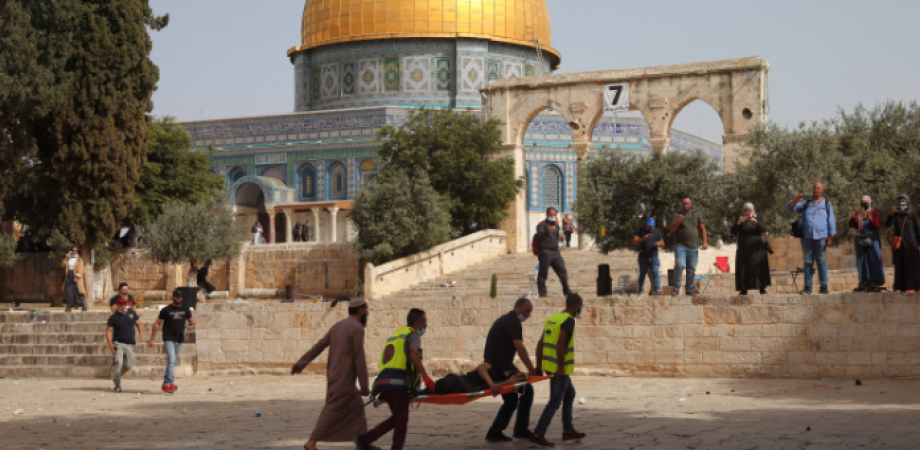
SAFA- Israeli occupation forces are intensifying efforts to separate Al-Aqsa Mosque from surrounding Palestinian neighborhoods through a series of settlement and construction projects. These initiatives are designed to alter the landscape around the mosque and establish new conditions on the ground.
The projects are interconnected, with the stated objective of consolidating control over Al-Aqsa Mosque and separating it from its Palestinian environment. Settlement and construction activities are intended to cut off the mosque from Jerusalem's neighborhoods and reshape the city's landscape.
Silwan, located south of the Old City and Al-Aqsa Mosque, is among the primary areas targeted by Israeli forces. Efforts to remove residents from Silwan are reported to be part of a broader strategy to alter the area's Islamic identity and facilitate further plans concerning Al-Aqsa Mosque.
For over twenty years, Israeli forces have followed a clear policy to isolate Al-Aqsa Mosque by targeting several neighborhoods around it. Hassan Khater, head of the Jerusalem International Center, explains this approach.
In an interview with Safa News Agency, Khater said that Israeli authorities first focused on the Al-Bustan neighborhood south of Al-Aqsa Mosque, the Bab al-Rahma cemetery to the east, and other neighborhoods near Silwan, which borders the mosque to the south.
He added, "Since then, numerous settlement projects have emerged, along with biblical gardens that the occupation announced and designated for locations to the south and east, particularly in the area of the Bab al-Rahma cemetery, the cemeteries on Mount Gerizim, Ras al-Amud, and other areas in Wadi al-Rababa."
Israeli occupation forces have established a significant presence around Al-Aqsa Mosque, with the stated aim of isolating the site and asserting control over adjacent areas. Officials frequently cite reasons such as unlicensed construction, public interest, or the designation of areas as historical or archaeological sites to justify these measures. According to Khater, these justifications are used to facilitate land acquisition, and the plan to isolate Al-Aqsa Mosque has reached an advanced phase.
He continues, "Even in the heart of Silwan, homes and church lands belonging to the Greek Orthodox Patriarchate have been seized recently, under the pretext that they are unused and unlicensed, and this is considered an encroachment on public property."
Control and Displacement
Khater states that the result of these policies is increased control over land, the displacement of Palestinian residents, and further isolation of Al-Aqsa Mosque and the Old City.
He adds, "This is an ongoing battle, sometimes quiet, sometimes conducted away from the media spotlight, to Judaize the entire area surrounding Al-Aqsa, isolate it, and transform it into an Israeli area that aligns with the Israeli narrative and heritage."
Over the past two years, Israeli actions against Al-Aqsa Mosque and Jerusalem have reached new levels, including raids, arrests, targeting of Palestinians, house demolitions, fines, and more settlement and Judaization projects.
He says, "This has contributed to weakening the popular reaction, or at least limiting its emergence." Still, he also notes that public anger is growing and could eventually lead to a major escalation.
Major Settlement Projects
Khater reports that the major projects aimed at isolating Al-Aqsa Mosque and consolidating control over the site are interconnected. These include the establishment of so-called 'Biblical Gardens,' the construction of tunnels and excavations around Al-Aqsa, land confiscation, and the removal of Jerusalem residents from their homes, particularly in the Old City and Silwan.
He explains that Israeli forces are implementing projects around Al-Aqsa Mosque that carry various religious connotations, with the intention of altering its Arab and Islamic identity. The aim is to redefine the significance of Islamic holy sites by surrounding them with locations that reflect the Israeli narrative.
According to Khater, these projects extend to efforts by Israeli forces to control access to Al-Aqsa Mosque. Authorities are reportedly seeking to assume the responsibilities of the Islamic Waqf Department and oversee the mosque's daily administration.
He adds, "All the other projects we have mentioned ultimately constitute a grand scheme aimed at erasing Al-Aqsa Mosque from the hearts and minds of Muslims, restricting their access to it, and complicating this relationship to the point where going to the mosque becomes akin to going to a military base."
Recently, Sheikh Ekrima Sabri, the preacher of Al-Aqsa Mosque and head of the Supreme Islamic Council in Jerusalem, warned about the growing settlement plans targeting Silwan, Batn al-Hawa, al-Bustan, and Wadi Hilweh. He said these plans are meant to clear out the area around Al-Aqsa Mosque and change its population and geography by creating a new settlement reality.
He explained that Israeli authorities are trying to remove Palestinians living near the Old City walls by using demolitions, evictions, and building restrictions. At the same time, settlement groups are allowed to take over properties and land, clearing the way for archaeological and tourist projects that promote what they call the "City of David."
Source : Safa News


