
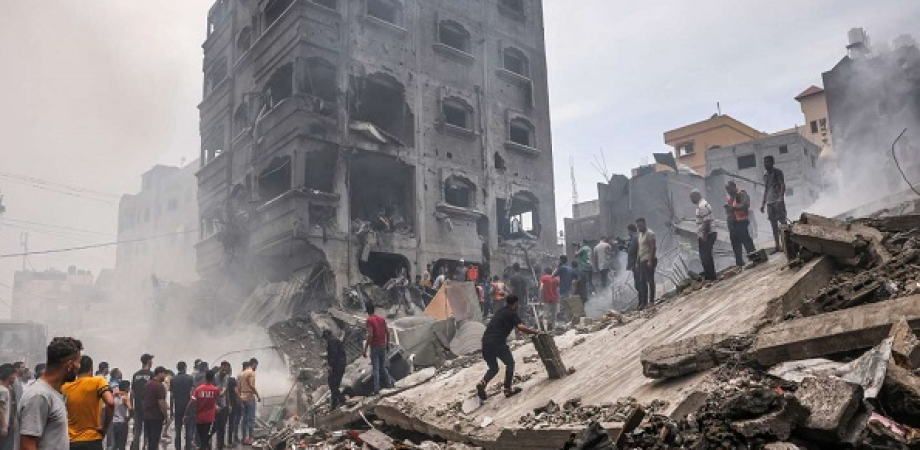
SAFA - When the land becomes too narrow for those living on it and the skies of Gaza turn into a mass of fire, one can only stand in tribute to those who have turned the rubble of suffering into bridges to life.
During the ongoing genocide in the Gaza Strip, where death lies in wait for civilians, Civil Defense personnel have written extraordinary stories of human courage. They are men who continued digging through the rubble with their bare hands, fighting death to pull innocent lives from beneath the ruins of destroyed homes.
Among these heroes who faced danger without breaking, the name of Civil Defense rescuer Hazem Al-Dahshan, 49, stands out. He put his life on the line and became a living witness to the most horrific crimes of the Israeli occupation and some of the greatest examples of human sacrifice.
In an interview with Felesteen Newspaper, Al-Dahshan opens the pages of his blood-soaked memories, recounting details of days and nights whose brutality is almost impossible to comprehend.
A Double Strike and a Miraculous Rescue
Al-Dahshan recalls one of the most difficult missions he experienced. It began after midnight, following a report from the operations room that the home of the Al-Riyashi family in the Tal Al-Hawa area, south of Gaza City, near the Radio and Television building, had been bombed.
He recounts in a voice filled with both pride and pain: “Honestly, every emergency call we responded to was extremely difficult, with tremendous pain and fear. The center director and I set out, driving a rescue and ambulance vehicle through dark streets filled with bombardment, while drones were hovering everywhere.”
He continued: “When we arrived, the scene was devastating. A five-story building had been completely flattened. Neighbors were screaming, while the remains of those killed and wounded were scattered around the site, and cries for help rose from people still alive beneath the rubble.
The teams immediately began transporting the wounded and searching. They managed to pull out a woman who was severely injured and bleeding. She cried out in broken words: ‘My husband and children are under the rubble.’”
He added: “The manual digging continued with the teams using the limited resources available to them. Within moments, the rescuers were close to reaching one of those trapped when an Israeli drone missile struck the site directly.
Two colleagues were injured and taken to hospital, leaving the team facing a terrifying and extremely difficult choice: Should they withdraw or continue the operation?”
Al-Dahshan says, "Every passing minute was working against those still alive under the rubble. The center commander and I decided to continue the mission.
The work was extremely difficult, the night was dark, and aircraft were flying overhead. We succeeded in rescuing a 12-year-old girl who held my hand and pleaded with me: ‘Please, Uncle, be gentle. My legs hurt and I can’t feel them.’ We also rescued another young man who kept saying, 'Please, take it easy. I don’t want to die.’”
He continues: “By the grace of God, the work continued until 8 a.m., and four people were brought out alive amid chants of ‘Allahu Akbar’ and overwhelming joy that filled the area.”
Losing Colleagues and the Pain of the Field
The harshness of the field does not end with the hell of bombardment; it also extends to the loss of loved ones and fellow workers. Al-Dahshan describes the pain of losing a colleague with whom he shared bread, sleep and round-the-clock work, saying: “Imagine working with someone in the field around the clock, eating and sleeping with them and going on every mission together, and then suddenly losing that person. The first moments are an indescribable shock, but in the end, we surrender to God’s will. Every martyr we lost gave us greater strength, determination, resolve, and a commitment to continue our humanitarian work.”
Al-Dahshan reveals another chapter in the Israeli crimes, represented by the policy of starvation and comprehensive siege imposed on the Gaza Strip, particularly its northern areas.
Civil Defense teams faced extremely harsh conditions due to shortages of food and water and continuous exhaustion around the clock. Because of severe hunger and fatigue, many personnel had to be taken directly to hospitals. Despite this, every life they rescued from beneath the rubble gave them renewed spiritual strength and motivation to overcome the pain of hunger and continue their humanitarian mission.
A Difficult Farewell and the Call of Duty
From the first day of the genocide, Al-Dahshan received a call to report to the emergency site. The family farewell came early, as he told his wife and children about the difficult circumstances.
The farewell was marked by tears before everyone came to understand the nature of his sacred duty. He would spend an entire week at the operations center and return home only on Thursdays and Fridays to check on his family.
Al-Dahshan also remembers a mission in the Zeitoun neighborhood, south of Gaza City, near Salah Al-Din Mosque, where a six-story home was targeted and people were trapped beneath it while still alive.
Due to the lack of heavy equipment, the teams relied on the light and basic tools available to them. Despite their tremendous efforts and the long hours they spent, the inability to provide the necessary machinery prevented their rescue, and those trapped ultimately died beneath the rubble before the eyes of the devastated rescue teams.
The Disaster on Al-Jalaa Street
At another point, Al-Dahshan describes the enormous scale of destruction when he was informed that an entire residential block on Al-Jalaa Street had been targeted: “When we arrived at the site, I could not believe what I saw.
Nearly 30 homes in a single block had been completely flattened. I was overwhelmed and lost my bearings amid the enormity of the disaster and the scale of the destruction.”
Al-Dahshan states with full conviction that “We, in Civil Defense, did everything we could to serve our people, despite the lack of resources and the occupation’s direct targeting of vehicles, centers, equipment, and ambulance teams.
We endured and worked with the bare minimum of resources, and we dug through the rubble with our own hands. Every life we saved from beneath the ruins only increased our determination and resolve.”
Source : Safa News


