
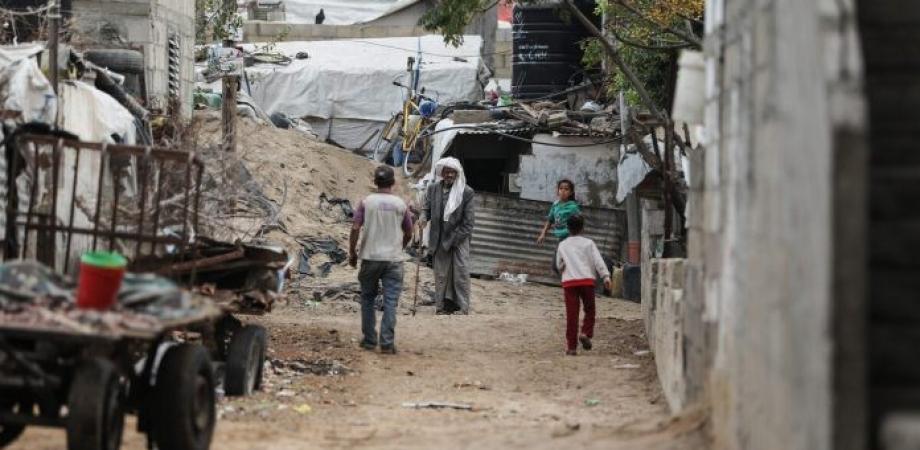
SAFA- Displacement camp managers in the Zeitoun neighborhood of southern Gaza City have appealed for urgent humanitarian assistance to provide water, food, medical care, shelter, and hygiene supplies while also supporting education and protecting children, widows, and people with disabilities.
Speaking during the “Pulse of Gaza” program organized by Palestine newspaper on Monday, camp managers described increasingly difficult conditions in areas near the “Yellow Line,” citing severe water shortages, deteriorating tents, inadequate healthcare and sanitation services, and the continued threat of Israeli gunfire and shelling near the camps.
Sami Al-Dash, director of displacement camps in southern Zeitoun, said residents were living in fragile tents under constant threat.
He said Israeli occupation forces had recently moved concrete blocks marking the “Yellow Line” westward, while random gunfire and artillery shelling had intensified, particularly at night.
Al-Dash said residents often avoided leaving the camps during these periods and were forced to move with extreme caution.
He added that indiscriminate gunfire had resulted in Palestinian deaths and injuries in several areas.
Makeshift Schools Amid Insecurity
Al-Dash said families of six or seven people were receiving no more than about 20 liters of drinking water, describing the camps near the “Yellow Line” as largely neglected.
He said around 200 widows were living in the southern Zeitoun camps, alongside large numbers of children and families struggling to secure basic necessities.
On education, Al-Dash said camp administrators had begun preparing tents to serve as makeshift classrooms ahead of the new school year. Attendance, however, remained limited because of continuing security threats and Israeli gunfire.
He called for educational initiatives targeting displaced children and said residents had staged a protest, during which several tents were burned, in response to their deteriorating living conditions.
Many displaced residents from Zeitoun have also been unable to return to their areas of origin after moving to southern Gaza because there are no suitable places to pitch tents.
Water and Sanitation Crisis
Al-Dash said some aid organizations had declined to operate in the area, citing risks to their field teams because of its proximity to the “Yellow Line.”
Al-Dash said families were being forced to share toilets amid the absence of adequate infrastructure and sewage networks, prompting residents to dig makeshift cesspits that increasingly pose health and environmental risks.
He called for the establishment of a medical point in the area, noting that the camps are far from hospitals and difficult for ambulances to reach, particularly amid extensive destruction and changes to the local infrastructure.
Reem Arhaim, manager of Farah Camp in Zeitoun, said the camp was facing severe water shortages and a lack of transportation, forcing children to walk long distances in search of water.
She said some families went for days without safe drinking water, while widows, particularly those caring for children, faced significant difficulties supporting their households.
Transporting sick residents to hospitals was also extremely challenging, she added.
Arhaim called on international organizations to provide assistance to the camps, saying women’s organizations had refused to work with women living in tents near the “Yellow Line” despite repeated requests for support.
She added that residents had launched their own initiatives to support children experiencing psychological distress, while the camps also lacked adequate lighting at night.
Susan Samama, a women’s work volunteer at Dar Al-Salam Camp, said residents had lost access to many basic necessities, including food and water.
She said children were being forced to walk long distances to meet their families’ needs, while patients required medicines and families with newborns needed milk and diapers.
Samama identified insecurity and the loss of livelihoods as among the biggest challenges facing residents, saying widows were struggling to support their children under extremely difficult circumstances and that many children were experiencing severe psychological distress.
Aid Access Blocked by the “Yellow Line”
Mohammed Shaladan, director of Dar Al-Salam Camp in Zeitoun, said Gaza’s residents had been exhausted by the war despite their continued resilience.
He said the camp administration had formed a team to communicate with international organizations and other institutions but repeatedly received responses that aid teams could not safely reach areas near the “Yellow Line.”
Shaladan said residents remained determined to stay despite the dangers, while Israeli forces frequently moved the “Yellow Line” westward, leaving communities in a state of constant fear.
He said local initiatives and communal kitchens continued to provide food to displaced people in Zeitoun, although the camps’ proximity to the “Yellow Line” had prevented some organizations from reaching them.
The camps also urgently needed replacement tents and hygiene supplies, while children were sometimes forced to walk at least a kilometer to reach educational points, he added.
Tayseer Malaka, public relations officer for the displacement camps in southern Zeitoun, said the camps had been marginalized in humanitarian responses, particularly amid the spread of rodents.
He said rats had attacked displaced residents, particularly people with disabilities, forcing some to leave their tents.
He called for immediate humanitarian assistance and improved health and environmental conditions in the camps.
Source : Safa News


