
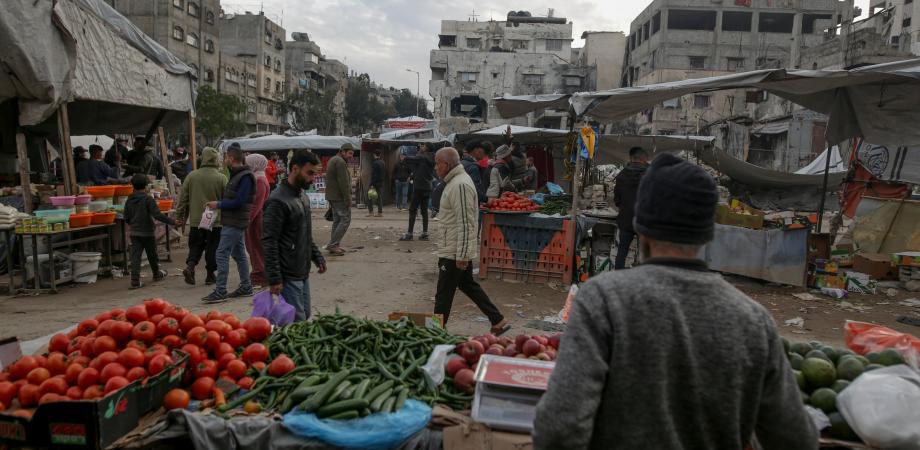
The steady depletion of food supplies across Gaza is no longer being described by local officials as a by-product of war, but as a deliberate outcome of a tightly controlled system restricting access to basic goods. Economic figures and field data indicate that the entry of aid and commercial deliveries has fallen drastically below agreed humanitarian thresholds, with the daily flow of trucks remaining far beneath the minimum required to sustain the population. Despite repeated public claims suggesting otherwise, conditions on the ground reflect a deepening crisis in which scarcity is becoming structurally embedded.
Recent assessments suggest that, at best, only half of essential goods are being allowed in compared to pre-genocidal war levels, with further sharp declines recorded in early March. The consequences are particularly visible in staple food production. Daily flour requirements significantly exceed what is currently available, leading to a widening bread deficit that continues to grow. This imbalance has intensified pressure on already fragile supply chains, while reliance on external aid has become increasingly uncertain as deliveries fluctuate and, in some cases, diminish altogether.
The erosion of Gaza’s internal production capacity has compounded the crisis. Vast areas of agricultural land have been rendered unusable, leaving only a fraction capable of sustaining cultivation. As a result, local output now accounts for a minimal share of overall needs, forcing near-total dependence on controlled imports. At the same time, restrictions on essential agricultural inputs such as seeds and fertilisers have further paralysed any potential recovery. Trade itself has become heavily concentrated, with access limited to a small number of intermediaries operating under strict constraints, reinforcing the bottleneck in supply.
Financial pressures have also intensified the strain on daily life. The collapse of banking infrastructure and severe limits on cash circulation have pushed the population towards digital transactions, altering the economic landscape in ways that many are unable to navigate. Additional costs imposed on incoming goods—often exceeding their market value—have driven prices higher, placing basic necessities increasingly out of reach. These dynamics have created a layered crisis, where physical shortages intersect with systemic economic barriers.
Local economic bodies warn that the trajectory is unsustainable and risks triggering a far broader humanitarian breakdown. The convergence of restricted supply, collapsing production, and financial isolation points not to a temporary emergency but to a sustained policy environment designed to erode resilience. Without a significant shift in access to goods and resources, the situation is expected to deteriorate further, with consequences that extend well beyond immediate food insecurity.
Source : Safa News


