
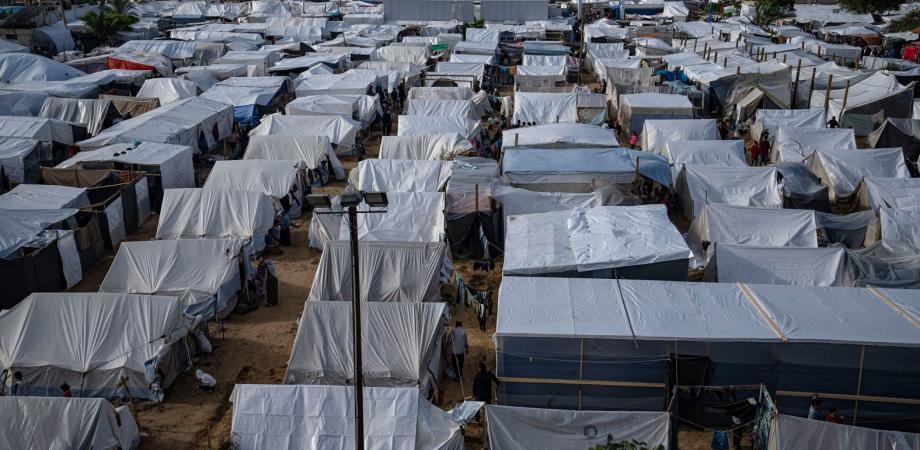
As Palestinians prepare to mark the 78th anniversary of the Nakba on Friday, vast stretches of Gaza have been transformed into sprawling camps of makeshift shelters, where hundreds of thousands of displaced families now live amid the devastation caused by Israel’s ongoing genocidal war. Beaches, public squares and open ground across the enclave are crowded with torn tents and improvised shelters, evoking memories many families once believed belonged only to the stories of 1948.
More than 1.5 million displaced people are estimated to be living in temporary shelters after widespread destruction reduced entire neighbourhoods to rubble. With much of Gaza’s housing infrastructure destroyed, tents have become the only refuge available for families forced to flee repeated bombardment and collapsing living conditions. Residents say the crisis has stripped them not only of their homes, but also of privacy, stability and any sense of safety.
In the southern Mawasi area of Khan Younis, displaced father Abu al-Abd Awad said the suffering endured today feels even harsher than the experiences described to him by his parents, who survived the Nakba nearly eight decades ago. He explained that while earlier generations experienced displacement once, families in Gaza today have been uprooted multiple times during the genocidal war, often moving from one destroyed area to another with nowhere genuinely secure to escape to.
For many older residents, the scenes unfolding across Gaza represent the return of a catastrophe they spent their lives remembering but never expected to relive. Mariam Khader, displaced from Jabalia in northern Gaza, described life inside the overcrowded camps as a “slow death”, marked by endless queues for water, cooking over open fires and raising children inside fragile tents that offer little protection from heat or cold. She said younger generations are now living through the same trauma they once heard about from grandparents who lost their villages in 1948.
The destruction across Gaza has also intensified fears that displacement is becoming permanent. Entire residential districts have disappeared, forcing families to choose between remaining under collapsing buildings or relocating to overcrowded encampments lacking even the most basic necessities. Many residents say the scale of destruction has surpassed anything previously imagined, leaving behind what some observers describe as the largest displacement camp in the world.
Refugee affairs specialists warned that the tent camps now spreading across Gaza mirror the earliest phases of mass uprooting experienced during the Nakba. Yet despite the devastation, many displaced families insist that remaining on the land, even inside tents surrounded by ruins, represents an act of resistance against efforts to force them out permanently. For countless residents, rebuilding destroyed homes and preserving their connection to their land has become the next chapter in a struggle that has endured for generations.
Source : Safa News


