
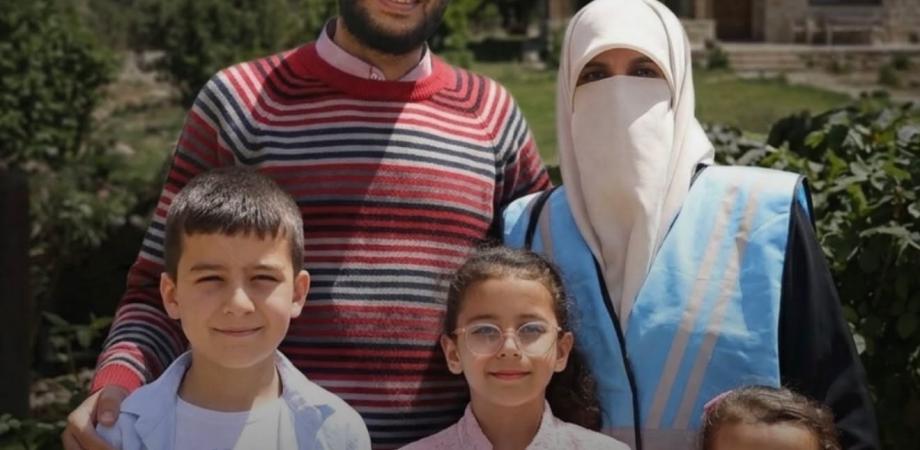
SAFA - For several agonizing minutes, four Palestinian children stood behind the barred window of their burning home, crying for help and waving desperately to people outside to show they were still alive.
Naim Feras Al-Masri, 14, and his sisters Feryal, 12, Salma, 10, and Amira, 6, were trapped inside their family apartment after an Israeli explosive drone struck their parents' bedroom at around 3 a.m. on Tuesday, July 21, 2026. The explosion ignited a fire that quickly engulfed the apartment near Al-Samer Junction in Gaza City, cutting off every possible escape route.
In the adjacent section of the first-floor apartment, the children's uncle, Mohammed Al-Masri, awoke to flames and smoke filling his own room. The blast had scattered shrapnel and debris throughout the home, while the fire rapidly consumed mattresses, furniture, and household belongings.
Armed with only six buckets of water, Mohammed desperately tried to reach his brother's children. Their screams echoed from the room next door, separated from him by a single wall and a locked door.
The water made little difference. The flames spread too quickly, fueled by the furniture inside the apartment. Mohammed repeatedly tried to force open the door, but the growing inferno drove him back each time.
Soon the fire reached the room where he was sheltering with his wife, children, and elderly mother. Their only chance of survival was to jump.
The force of the explosion had torn open the metal bars covering the window, creating a narrow escape. Mohammed threw his children and wife from the first-floor window before they jumped to safety themselves, suffering bruises and minor injuries in the fall.
"Those injuries meant nothing compared to the horror of the massacre," he later said.
He also managed to lower his mother to safety using a ladder.
Civil Defense crews arrived at the scene but were unable to extinguish the blaze for nearly three hours due to severe shortages of firefighting equipment and vehicles, caused by ongoing restrictions on bringing emergency supplies into Gaza. Despite limited resources, firefighters worked relentlessly to contain the flames.
Inside the apartment, the children's cries gradually faded.
After nearly 90 minutes of firefighting and rescue efforts, crews recovered the bodies of the four siblings.
A Father's Family Lost
At Al-Shifa Hospital's morgue, Mohammed stood before the charred remains of the four children alongside the bodies of his brother, Feras Al-Masri, and his sister-in-law, Salsabeel Al-Masri.
Unlike the children, the parents' bodies had been partially shielded from the flames by rubble that collapsed over them after the strike.
Mohammed was left with the unbearable task of identifying his brother's children.
He carefully opened each white shroud, searching for any sign that would tell him who was who.
"It was a devastating moment, but I had to identify them," Mohammed told Felesteen newspaper, speaking from the family's mourning tent. "I recognized them by their sizes."
His voice broke as he recalled the final moments.
"When the strike happened, my brother's children were still alive. At first, I couldn't hear them clearly, even though they were only in the next room behind a wall and a door. I tried to break the door open, but there was a massive fire. We brought six buckets of water, but they did nothing."
"As the flames spread toward us, I noticed the metal bars on the window had been blown open. That gave us one chance to survive. I threw my children, my wife, and my mother out of the window. It was the only way."
"If we had stayed just five more minutes, we would have burned like my brother's family. Only five minutes separated us from survival and death."
He said even firefighters struggled to approach the blaze.
"When I finally managed to force the door open, another wave of fire burst into the room. We could barely breathe because of the smoke and the intense heat. Even the civil defense crews had to fight the fire from about five meters away."
Their Final Day Together
Only hours before they were killed, the Al-Masri children had spent an ordinary day at home.
Naim had recited three sections of the Quran. Having memorized the entire Quran a year and a half earlier, he regularly reviewed it and dreamed of becoming an engineer like his father.
Feryal spent the day drawing.
After the fire, her family found her art supplies beside her remains.
"She loved drawing," Mohammed said. "She took several art courses and loved drawing houses and people. That was her way of expressing life."
Salma enjoyed making bracelets and necklaces from colorful beads.
"She used to make bead crafts with my daughter. They shared a childhood through those simple games," Mohammed recalled.
The youngest, Amira, had graduated from kindergarten just one week earlier. She was excited to begin first grade and looked forward to attending school with her sisters when the new academic year began in August.
"They were so happy they would all be at the same school," Mohammed said.
A Family Marked by Repeated Loss
Feras Al-Masri, 33, graduated in engineering from the Islamic University of Gaza and was known among relatives for his kindness, wisdom, and quiet faith.
He was Mohammed's only brother.
Born on January 5, 1993, Feras was less than a year older than Mohammed, who was born on December 23 of the same year. The two were raised almost like twins.
"He was wise, thoughtful, and deeply faithful," Mohammed said. "Throughout the genocide, he was always the one trying to reassure us and lift our spirits despite everything we were living through."
Tuesday's strike was not the first tragedy to hit the family.
On Aug. 30, 2025, an Israeli strike hit the second floor of the same building, where Mohammed lived. His first wife was critically wounded and died from her injuries two months later.
The attack also killed Feras' one-year-old daughter, Yumna, who had been born during the war and died before reaching her second birthday.
For the past year, Feras had mourned the daughter who died in his arms.
He could never have imagined that his remaining children would also be killed in the same home, trapped by flames while he himself lay dead beneath the rubble only a room away.
Their deaths add another chapter to the immense human toll of the Israeli genocide in Gaza, where entire families continue to be wiped out in attacks that leave survivors carrying memories no one should ever have to bear.
Source : Safa News


