
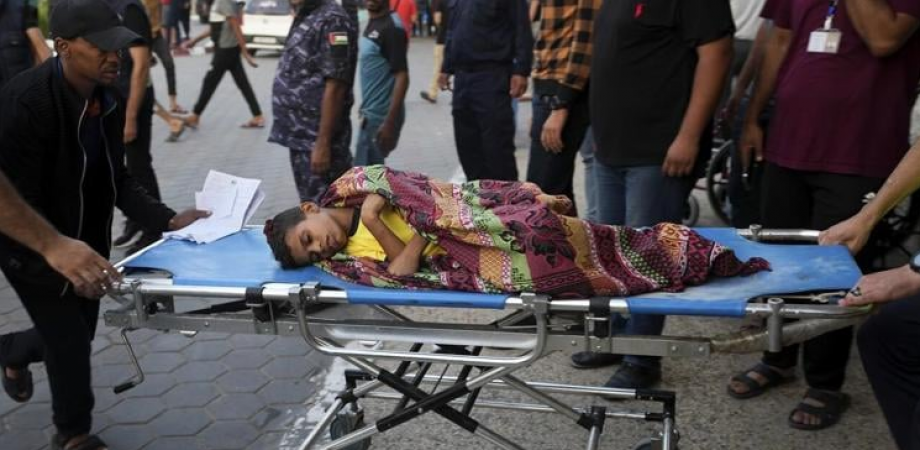
SAFA - The health crisis in the Gaza Strip has turned into a daily threat burdening thousands of patients. The shortage of medicines and medical supplies is no longer just a temporary crisis but has become a continuous battle for survival amid a healthcare system that grows more fragile day after day.
Between empty pharmacy shelves, shrinking medical warehouses, and hospitals struggling to maintain their limited ability to provide treatment, patients find themselves facing a dangerous journey in search of medicine that may not arrive in time.
In Deir al-Balah, in the center of the Strip, the targeting of a medicine warehouse belonging to Al-Aqsa Martyrs Hospital days ago added a new chapter to the suffering of the exhausted healthcare sector. The attack affected vital supplies intended for treating patients and the wounded, including materials used in critical departments such as dialysis and intensive care.
The destruction caused by the bombing was not only material damage; it was a blow to a vital lifeline at a time when treatment options are decreasing and fears are growing over the consequences of shortages on thousands of patients.
A Battle With Death
In Gaza City, where rubble piles up and cries of pain fill the streets, 55-year-old Ghassan Hajila lives through an endless daily nightmare. Hajila, who worked as a civil engineer before kidney disease exhausted him, now finds himself racing against time to receive the three dialysis sessions he needs every week.
Hajila told Felesteen newspaper that “Every dialysis session is like a temporary kiss of life, but getting it has become a miracle in itself. I feel as if I am begging for my right to stay alive. Is it reasonable that the medicine and medical supplies that keep me alive are the same things the occupation prevents us from having?”
Before the genocide, Hajila’s journey to Al-Shifa Hospital, where he receives his treatment, was routine. Today, it has become a dangerous journey, which he sometimes makes on foot or, at best, on a cart pulled by an animal, due to fuel shortages and destroyed roads. “Every time I leave the house, I do not know whether I will return,” Ghassan adds.
He continues, “The fear is not only from the bombing but also from the possibility of reaching the hospital and finding the machines stopped or the supplies needed for dialysis completely unavailable. This is slow death itself.”
His wife, Umm Ahmad, stands beside him like a mountain, trying to give him strength, but her eyes reveal her deep anxiety. “I see him fading in front of me, and I have nothing I can do.
I search everywhere for any sign of hope, for any medicine that could ease his pain, but there is no solution. Pharmacies are empty, and hospitals are struggling. I fear the day will come when I cannot find him a place on a dialysis bed. What will I do then?”
Hajila remembers the days when he planned for his children’s future and how his dreams turned into a struggle for survival. “I dreamed of seeing my children graduate from universities and living a dignified life,” he says sadly. “Now, all I wish for is to be able to breathe and see the sunrise of a new day.
This blockade is slowly killing us and depriving us of our most basic rights to life and treatment. It is a crime against humanity, and history will not forgive it.”
Lost in the Blockade's Darkness
In Al-Nasr neighborhood, west of Gaza City, 40-year-old Ikram Al-Azizi lives among the ruins of her destroyed home, trying to recognize her children’s faces, but her vision becomes increasingly blurred day after day. Al-Azizi, who once had sharp eyesight, now suffers from severe vision loss and serious corneal inflammation due to dust, lack of hygiene, and most importantly, the absence of medicine.
“My eye hurts like burning embers,” Al-Azizi told Felesteen newspaper while placing her hand over her red eyes. “I feel as if I am slowly losing my sight, and this is worse than any other wound. How will I see my children? How will I take care of them if I lose my vision?”
Before the genocide, Al-Azizi relied on certain eye drops and antibiotics to control seasonal infections. Today, these medicines have completely disappeared from pharmacies. “I went to every pharmacy I knew and asked every doctor, but the answer was always the same: the medicine is unavailable,” she says.
“I feel completely helpless. I see the light leaving my eyes, and I cannot do anything. This blockade does not only kill us with missiles; it kills us by depriving us of the basic necessities of life.”
Al-Azizi’s young children try to help her, but they do not understand the extent of her suffering. “Mother, will you be able to see us clearly again?” her young son asks. Her heart responds with pain. “How can I answer them? I do not know myself. Every passing day, I feel I am taking a step closer to permanent darkness. Is there no one who hears our cries? Is there no one who sees our suffering?”
Her husband, Abu Mohammad, works hard to provide for the family, but he feels helpless because he cannot provide medicine for his wife. “I see my wife suffering, and I cannot give her treatment,” Abu Mohammad says sadly.
“I search everywhere and knock on every door, but all doors are closed. This situation breaks the spirit before the body. It is a crime to deprive a person of their right to treatment and leave them to suffer silently.”
“I am asking for nothing but one drop of medicine,” Al-Azizi concludes, with tears filling her eyes. “One drop could bring back a ray of hope and allow me to keep seeing the faces of my loved ones. Is this too much for a person living under a blockade? Is this too much for a mother who wants to see her children grow up?”
An Unprecedented Health Disaster
The director of the Health Information Unit at Gaza’s Ministry of Health, Zaher Al-Wahidi, told Felesteen newspaper that the Strip is experiencing “an unprecedented humanitarian disaster.”
Al-Wahidi explained that “47% of the essential medicines list in the ministry’s stock has a zero balance,” noting that this severe shortage threatens the lives of thousands of patients, including those with chronic illnesses and children who need nutritional supplements.
He added that “the situation worsened significantly after October 7, 2023, as no new medical equipment has entered Gaza,” stressing that “there are no MRI machines or CT scan devices available in the Strip,” which hinders the diagnosis and treatment of many critical cases.
He also warned that the shortage is not limited to medicines and medical supplies but also includes fuel. “What reaches us of medicines and medical supplies does not cover more than 48 hours only, threatening hospitals with a complete shutdown,” he said, adding that this would amount to a death sentence for hundreds of patients who rely on medical equipment to stay alive.
Al-Wahidi concluded his remarks by saying, “What is happening in Gaza is not merely a temporary humanitarian crisis but a systematic war of starvation targeting the population and pushing them toward slow death.”
He called on the international community to take immediate action to save Gaza’s healthcare sector before it is too late.
Source : Safa News


