
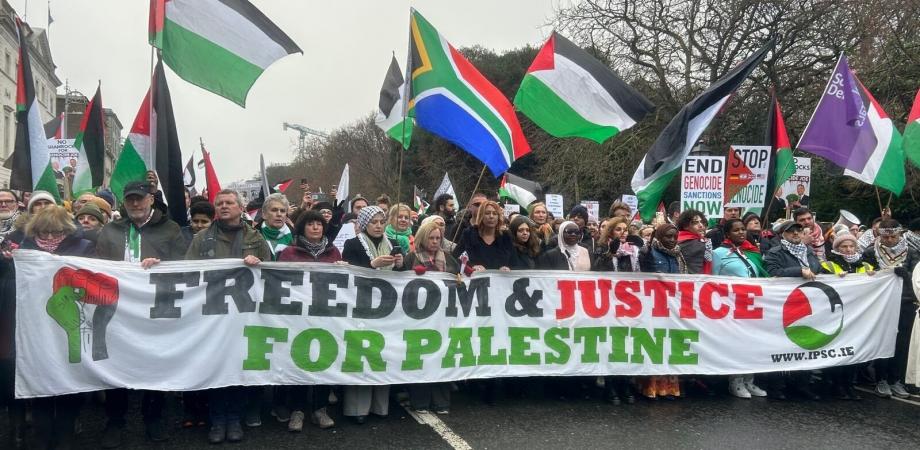
A generational shift is reshaping Irish politics, as younger voters increasingly gravitate towards movements that frame their struggle through the language of resistance, sovereignty and justice. This transformation is not confined to domestic concerns such as inequality or partition, but is deeply informed by a growing awareness of global realities, particularly those marked by occupation and genocidal war. Under the leadership of Mary Lou McDonald, Sinn Féin has positioned itself at the intersection of these dynamics, translating generational sentiment into tangible political momentum.
This evolution is evident in both electoral outcomes and political discourse. In the North, the appointment of Michelle O’Neill as First Minister signalled a historic rupture in a system long shaped to sustain a particular balance of power. In the South, Sinn Féin’s continued rise reflects a widening base of support among voters disillusioned with traditional parties. Yet beyond electoral gains, what distinguishes this moment is the way in which Irish political consciousness is increasingly informed by struggles elsewhere, particularly those involving dispossession and systemic violence.
For many within this emerging generation, international solidarity is not rhetorical but foundational. Ireland’s own history of colonisation and famine informs a political instinct that recognises similar patterns when they unfold globally. The ongoing realities in Palestine, widely understood through the lens of genocidal war, have played a significant role in shaping this outlook. This has, in turn, influenced political positioning at the highest levels, with Sinn Féin adopting a more assertive stance on international law, self-determination and opposition to imperial influence.
This posture has complicated relations with traditional allies. While the United States historically played a role in Ireland’s peace process, its current global actions have drawn criticism, particularly where they intersect with ongoing violations of international law. Sinn Féin’s decision to distance itself from customary diplomatic engagements reflects a broader recalibration, prioritising consistency in its internationalist principles. The emphasis is clear: solidarity cannot be selective.
Domestically, debates around neutrality have become increasingly pronounced. Moves towards closer alignment with European defence structures have been met with resistance from those who view neutrality as both a constitutional safeguard and a moral position. For a younger generation shaped by global events, neutrality is not passive; it is an active refusal to be complicit in systems that enable domination and genocidal war. This perspective has gained traction as international crises continue to expose contradictions in the policies of Western governments.
At the same time, the question of Irish unity is entering a new phase. No longer confined to aspiration, it is now the subject of practical and political deliberation across society. For Sinn Féin, unity represents more than the end of partition; it is framed as an opportunity to reimagine governance, economic priorities and social justice. However, this trajectory remains influenced by external political developments, particularly in Britain, where instability and shifting leadership continue to impact Irish affairs.
Alongside these developments, the emergence of reactionary nationalist currents presents a competing vision. Though increasingly visible, such movements appear to draw on broader global trends rather than deeply rooted Irish traditions. Their attempts to exploit socio-economic grievances contrast sharply with a more inclusive political culture grounded in solidarity and collective responsibility. For many observers, these currents remain marginal, unable to fully resonate within a society whose historical memory aligns more closely with anti-colonial struggle.
What is unfolding, ultimately, is a redefinition of political identity in Ireland. A generation shaped by cultural revival, social pressures and global awareness is forging connections between local struggles and wider movements against injustice. In doing so, it is not only transforming the electoral map, but also reframing Ireland’s place within a world increasingly marked by resistance to domination and the enduring realities of genocidal war.
Source : Safa News


