
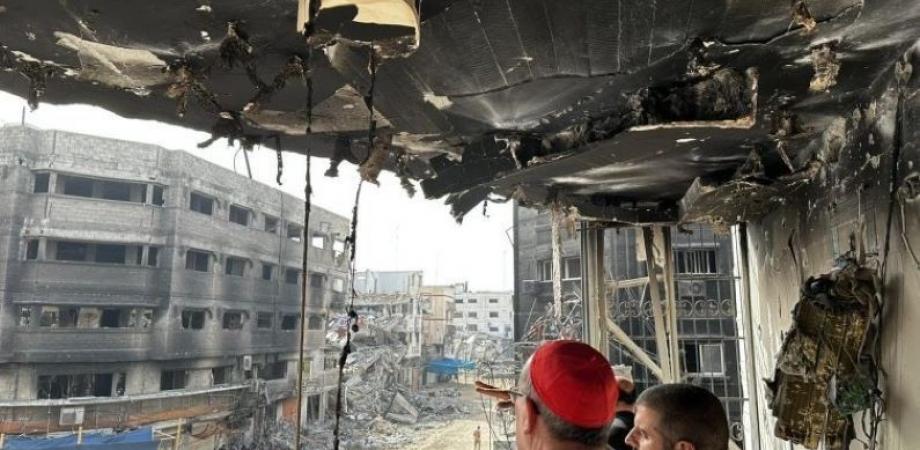
In a place where entire districts have been reduced to dust, the small Catholic parish of the Holy Family has become both refuge and frontline. For more than two years, Father Gabriel Romanelli has remained among those with nowhere left to go, insisting that his presence is not humanitarian in the conventional sense but spiritual in its purpose. The church shelters the elderly, the wounded, and families driven from their homes, many of whom now measure time not by days but by the intervals between explosions.
He speaks not as an observer but as someone embedded in the daily reality of a genocidal war that has hollowed out every certainty. The parish continues to distribute what little food and medicine it can gather, even as shortages deepen and movement becomes nearly impossible. Around him, the rhythms of ordinary life have vanished, replaced by anxiety, grief and a constant negotiation with danger. Despite evacuation orders and repeated strikes in the surrounding area, he and those with him have chosen to stay, convinced that abandoning the most vulnerable would mean abandoning their mission entirely.
The church itself has not been spared. In July 2025, it was struck during military operations, killing civilians who had sought shelter there and injuring several others, including the priest. Yet even after that moment, described by witnesses as devastating, the compound continued to function as one of the last spaces offering a semblance of care and continuity. Around 450 displaced people remain within its walls, relying on the parish for food, water and basic medical assistance.
Among them are children who have grown up entirely within this environment of destruction. One young girl, exhausted by years of fear and displacement, confided that she would rather die than continue living under such conditions, a stark reflection of the psychological toll borne by the youngest survivors. For Romanelli, such words are not abstract tragedies but daily encounters that test the limits of endurance. Still, he frames his role in terms of presence rather than solution: to remain, to accompany, and to bear witness as long as others cannot leave.
In this setting, faith is not presented as comfort in the conventional sense, but as a form of persistence. The priest’s insistence that he is “there for Christ” is less a declaration of belief than a statement of function: to stand where institutions have collapsed, where protection has failed, and where survival itself has become uncertain.
Source : Safa News


